

You've been going back and forth on this for longer than you'd like to admit. The duffel is roomy and easy to pack. The backpack keeps your hands free. Both seem fine — until you're sprinting through a terminal or stuffing your bag under a bus seat, and suddenly one of them is very obviously wrong for the job.
The duffel vs. backpack debate isn't really about which bag is better. It's about which one fits your specific trip. Once you map that out, the answer is usually obvious. Here's how to do it.
1. How You're Getting There
This is the single biggest factor most people ignore. If you're driving to your destination and loading gear into a trunk, a duffel wins almost every time. It's flexible, it squishes into odd-shaped spaces, and you're not carrying it for long stretches anyway.
But if you're hopping on a train, navigating a subway, or walking more than a few blocks between connections, a backpack distributes weight across your shoulders and keeps your hands free. A heavy duffel hanging off one shoulder for twenty minutes is a fast track to a sore neck.
Road trip or short drive to the venue? Duffel. Multi-leg transit journey? Backpack.
2. How Much Gear You're Actually Carrying
Duffels tend to have more raw volume for the same footprint, which makes them the go-to for gear-heavy trips — think a weekend baseball tournament, a camping trip where you need bulky layers, or a team travel situation where you're packing cleats, a helmet, and a change of clothes all at once. You can pile things in without trying to Tetris everything into pockets.
Backpacks reward travelers who pack light and organized. The structured compartments keep smaller items accessible, and you're less tempted to overload because your back will tell you immediately if you did. If your kit is mostly clothes and a few accessories, a backpack keeps things tidy without wasted space.
Gear-heavy, bulky load? Duffel. Lean, organized kit? Backpack.
3. Whether Your Bag Needs to Be a Carry-On
This one's non-negotiable if you're flying. Most airlines have overhead bin size restrictions, and a duffel's soft sides mean it can technically compress to fit — but a large duffel often gets gate-checked while a properly sized backpack slides in without a second look. If you're determined to avoid checked baggage fees, a backpack in a standard carry-on size is the safer bet.
That said, if you're checking a bag anyway, a duffel's flexibility is an advantage: it can be stuffed fuller than a rigid suitcase and still zip shut.
4. The Doubles-as-a-Day-Bag Question
Some trips call for one bag that goes from the hotel to the stadium to dinner. A backpack handles that transition more naturally — it's socially neutral enough to wear anywhere, and the shoulder straps make it comfortable for all-day carry. A large duffel is awkward to lug around a theme park or a city for six hours.
If your bag is staying in the car or the hotel room between uses, this doesn't matter. But if you need one bag to do everything on a busy travel day, the backpack is the more versatile tool.
5. Fan Gear and the Stuff That Doesn't Fit Neatly Anywhere
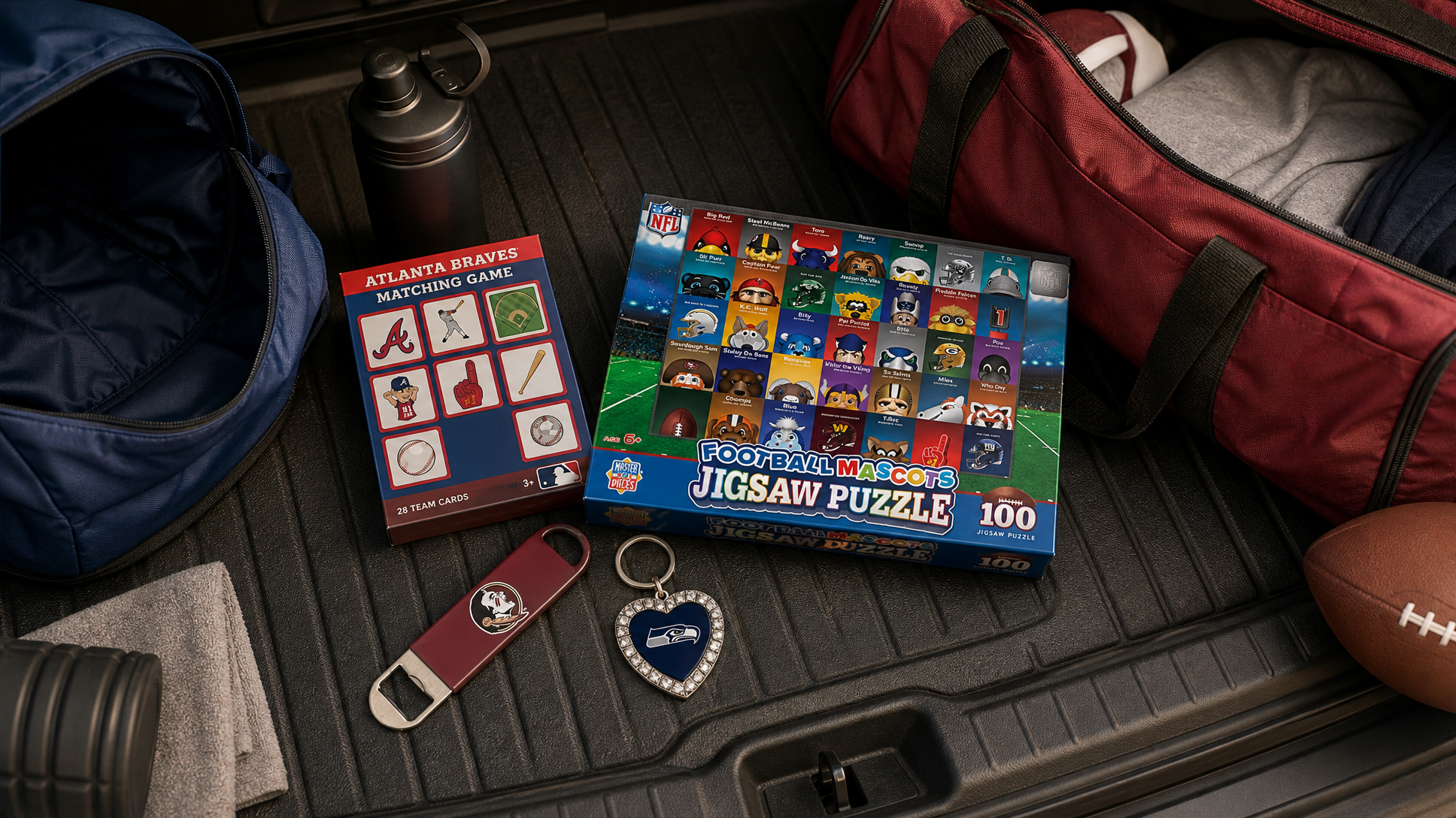
Here's the scenario that breaks both formats: you're traveling to a game and you've got the usual clothes, plus a team keychain, a matching game for the kids to play at the hotel, a puzzle for the long drive home, and a bottle opener for the tailgate. None of that is heavy, but it's oddly shaped and you don't want it rattling around loose.
This is where a bag with interior pockets and a flat base — whether duffel or backpack — earns its keep. Small accessories like the Rico Industries NFL Seattle Seahawks Metal Rhinestone Heart Keychain (a rhinestone-bordered heart charm in navy blue with the Seahawks logo) can clip to a zipper pull or slip into a small pocket so they're not buried under everything else. The NCAA Florida State Seminoles Covered Long Neck Bottle Opener — a sturdy, garnet-red bar-style opener with the FSU Seminoles logo — is flat enough to tuck into any side pocket without taking up real estate.
Boxed items like the Atlanta Braves Matching Game and the NFL Mascot 100 Pc Puzzle are the real packing challenge. Both are rigid, flat boxes that sit awkwardly in a duffel unless you pack them last, on top. In a backpack with a flat back panel, they slide in cleanly against your spine. If you're bringing games and puzzles on a road trip or team travel weekend, the backpack actually handles them better — counterintuitive, but true.
So Which One Should You Actually Buy?
If you're still on the fence after working through those five questions, here's the short version:
- Get a duffel if you're driving, checking a bag, carrying bulky gear, or need maximum volume without caring much about organization.
- Get a backpack if you're flying carry-on only, using transit, walking long distances, or need one bag to carry through a full game-day itinerary.
Neither is universally better. The right call is the one that fits how you actually travel — not how you imagine you travel.
Browse the full range of bags and packs at OnlineSportsMall to find the format that fits your next trip, and check out the accessories collection for fan gear worth packing alongside it. New customers can use code WELCOME5 for 5% off their first order.
Frequently Asked Questions
Can a duffel bag be used as a carry-on on a plane?
It depends on the size and the airline. A smaller duffel can fit in an overhead bin, but soft-sided bags are harder to size accurately, and a large duffel often gets gate-checked. If avoiding checked baggage is important to you, a backpack sized to your airline's carry-on limits is the more reliable choice.
Which is better for a sports weekend trip — a duffel or a backpack?
For most sports weekend trips where you're driving, a duffel is easier to load and unload from a car and handles bulky gear like cleats, helmets, or layers without much effort. If you're using public transit at any point or need to carry the bag for extended periods, a backpack is more comfortable. The best answer depends on your specific commute.
How do I pack board games or puzzles in a travel bag without damaging the box?
Flat, rigid game boxes travel best when packed vertically against a firm surface — the back panel of a structured backpack works well for this. In a duffel, pack them last so they sit on top rather than getting compressed under heavier items. Wrapping the box in a layer of clothing adds some cushion if you're worried about the corners.
What's the best way to keep small fan accessories from getting lost in a travel bag?
Use a small zippered interior pocket if your bag has one — most backpacks do. Keychains can clip directly to an interior or exterior zipper pull so they're always findable. Flat items like bottle openers slip easily into a side pocket. The key is committing to one spot for small accessories at the start of the trip so you're not digging through the whole bag every time.