

If you've ever had your forearms give out before your back does on a deadlift, or felt a nagging ache in your wrist after a long tennis session, you've already experienced the gap between grip strength and wrist strength — you just didn't know which one was failing you.
Most people use the terms interchangeably. They're not the same thing, and training the wrong one first is one of the most common reasons athletes plateau, develop overuse injuries, or wonder why their forearms still feel like a weak link despite months of training.
Here's how to tell them apart, why it matters, and how to train each one deliberately.
What Grip Strength Actually Is
Grip strength is your ability to generate and sustain force with your fingers and hand around an object. It's what keeps a barbell in your hands during a heavy pull, what holds a climbing hold when your legs are pumped, and what stops a baseball bat from flying out of your hands mid-swing.
The muscles doing this work are mostly in your forearm — the flexors that run from your elbow down into your fingers. Your hand is largely tendons and small intrinsic muscles; the real power comes from further up the chain. Grip strength is primarily a closing force — fingers wrapping, squeezing, and holding.
Where grip strength tends to fail: heavy pulling movements (rows, deadlifts, pull-ups), racket sports during long rallies, any sport that involves holding a tool or implement under fatigue.
What Wrist Strength Actually Is
Wrist strength is about stability and controlled movement of the wrist joint itself — flexion, extension, radial and ulnar deviation, and rotation. It's what keeps your wrist from collapsing when you push off the ground in a push-up, what controls a tennis racket through contact, and what protects you when you catch yourself in a fall.
The muscles involved overlap somewhat with grip training, but wrist strength specifically demands that the joint can resist and produce force across multiple planes of motion — not just squeeze in one direction.
Where wrist strength tends to fail: push-based movements (push-ups, bench press, overhead press), racket and bat sports where the wrist has to absorb impact, gymnastics, and any activity where the wrist is loaded in extension.
Why Confusing Them Causes Problems
Train only grip strength and you'll build a powerful squeeze — but a wrist that buckles under load or torques awkwardly through a swing. Train only wrist stability and you might have a solid joint but still drop the bar when things get heavy.
The injury risk is real. Wrist tendinopathy, golfer's elbow, and lateral epicondylitis (tennis elbow) are all conditions that can develop when one quality is chronically underdeveloped relative to the demands placed on it. This isn't a fringe concern — it's what happens when athletes train hard without training smart.
So which one should you train first? That depends on your sport and your current weak link — but for most people starting out, wrist stability comes first. A mobile, stable wrist joint is the foundation everything else loads onto. Building grip strength on top of an unstable wrist just means you're loading a compromised structure harder.
The Right Tools for Each Quality
This is where it's worth being specific, because the wrong tool genuinely won't move the needle on the right quality.
For Wrist Stability and Forearm Strength: Dmoose Fitness Flex Bar (Blue-Heavy)
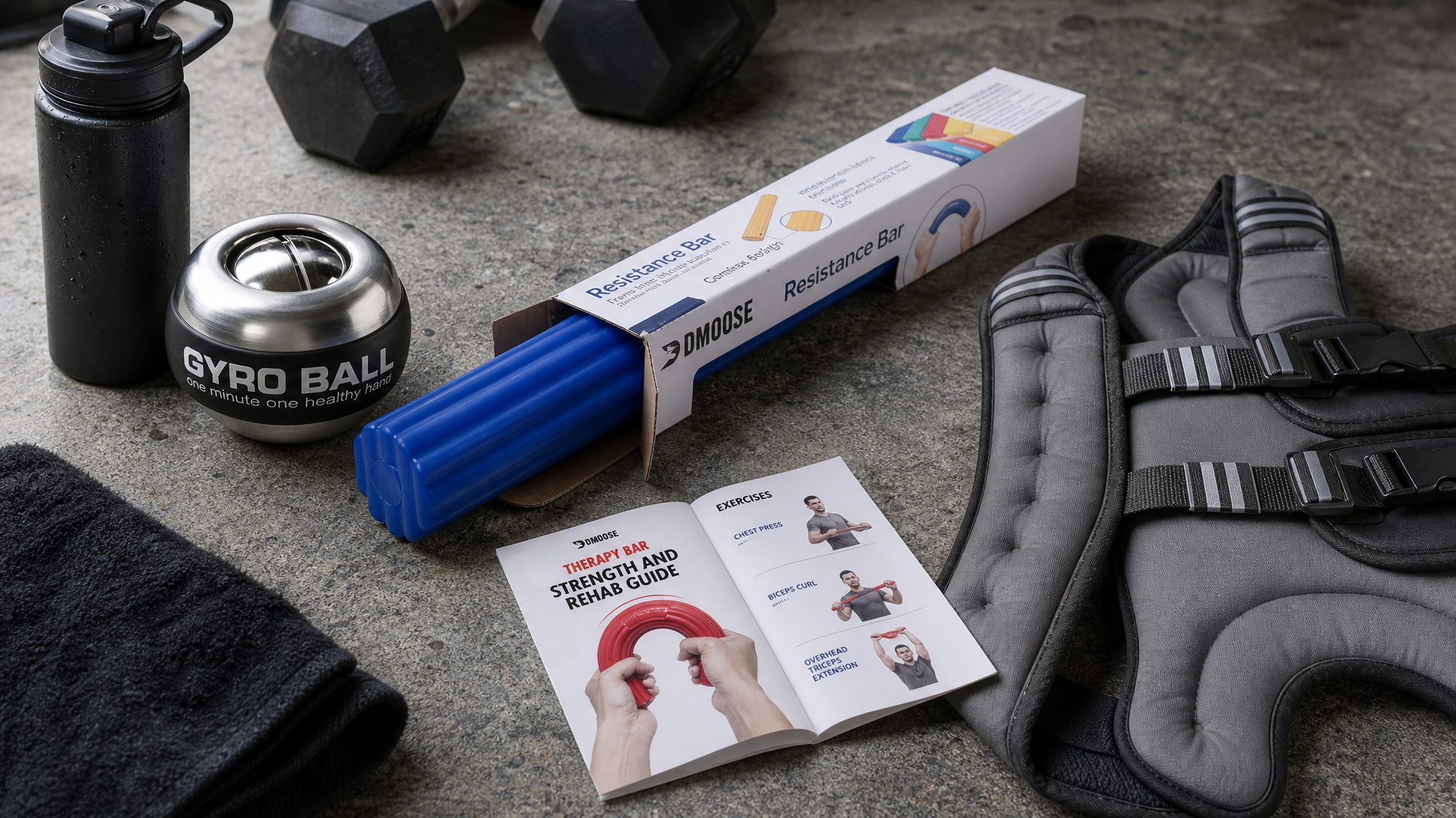
The Dmoose Fitness Flex Bar is a ridged, cylindrical rubber bar — the blue variant is the heavier resistance option — designed to be twisted, bent, and flexed through a range of motions that directly challenge the wrist and forearm in multiple planes. You're not just squeezing it; you're twisting it, bending it end to end, and resisting its tendency to snap back.
That twisting and bending motion is what makes it particularly effective for wrist stability work. The resistance is distributed across the movement arc, so your wrist extensors, flexors, and rotators all have to work together to control it — rather than just your finger flexors doing all the work as they would on a grip trainer. It also comes packaged with a Strength and Rehab Guide, which is a useful starting point for structuring your sessions.
This is the tool physical therapists and strength coaches often reach for with athletes recovering from tennis elbow or managing forearm overuse — the controlled eccentric twist is well-established as a rehab and prehab movement for lateral elbow pain. If your wrist stability is the gap, start here.
For Grip Endurance and Wrist Rotation: Gozato Auto-Start Wrist Power Gyro Ball
The Gozato Gyro Ball is a compact, metal-shelled gyroscopic device — silver with a black rubber band around its equator — that spins an internal rotor when you move your wrist in a circular motion. Once it gets going, the gyroscopic resistance increases the faster you spin it, creating a load that challenges your grip, your wrist rotators, and your forearm endurance simultaneously.
What it trains specifically is your wrist's ability to maintain circular, rotational control under increasing resistance — a quality that's directly relevant to racket sports, golf, baseball batting, and any overhead throwing motion. It also demands sustained grip engagement to keep the ball in your hand while the rotor tries to pull it in different directions.
The auto-start mechanism means you don't need a pull cord to get it spinning — you just move your wrist and it engages. That makes it practical for desk use, between sets, or during a commute. Short, frequent sessions with a gyro ball tend to build forearm endurance faster than occasional long sessions, so the portability matters.
If grip endurance and rotational wrist control are your gaps — common in racket sport athletes and climbers — the Gozato is the tool that addresses both at once.
How to Sequence Them in Your Training
You don't have to choose one or the other forever. Most athletes benefit from addressing both, just in the right order and proportion.
If you're starting from scratch or coming back from a wrist injury: Begin with the Flex Bar. Focus on controlled flexion, extension, and twisting movements. Build joint stability before you start loading grip endurance on top of it. Two to three short sessions per week is enough — this isn't volume training, it's quality work.
If you have a solid foundation but want to build forearm endurance and rotational control: Add the Gyro Ball. Use it at your desk, in the car, or as a warm-up before sport-specific practice. The resistance scales with effort, so it grows with you.
If you play a racket sport, golf, or baseball: You need both. The Flex Bar handles the structural stability; the Gyro Ball handles the sport-specific rotational endurance. Run them in parallel once your wrist stability is solid.
And if you're adding load to your overall training — like wearing a Prodigen Weighted Vest for bodyweight work — keep in mind that push-up variations and loaded carries under a vest will place additional demand on your wrist stability. That's another reason to get the foundation right before piling on load.
For more on building a complete training kit without buying gear you won't use, this guide on sport-specific kit building is worth a read.
The Bottom Line
Grip strength and wrist strength are related, but they're not the same muscle quality, they don't fail in the same situations, and they don't respond to the same training tools. Getting clear on which one is your actual weak link — and then using the right tool to address it — is the difference between training that moves you forward and training that just keeps you spinning your wheels.
Build the stable wrist first. Then load it. Then make it endure. In that order, you're building something that lasts.
Shop the Dmoose Fitness Flex Bar and Gozato Gyro Ball at OnlineSportsMall — free US shipping on orders over $75, with 30-day returns on every order.
Frequently Asked Questions
Can I train grip strength and wrist strength on the same day?
Yes — and for most people, that's the practical approach. Just sequence them correctly: do your wrist stability work (like Flex Bar exercises) before grip-intensive work, not after. When your wrist stabilizers are pre-fatigued, your form on grip-heavy movements tends to break down, which is when injuries happen.
How long does it take to see improvement in grip and wrist strength?
With consistent, focused training a few times per week, most people notice meaningful improvement in grip endurance and wrist stability within four to six weeks. Neurological adaptations happen quickly — your muscles learn to coordinate better before they actually grow — so early gains are often about efficiency, not just raw strength.
Is the Gozato Gyro Ball suitable for rehab, or is it only for performance training?
Gyro balls are commonly used in rehabilitation settings for gentle wrist and forearm activation, but the intensity is self-regulated by how fast you spin it. If you're recovering from an injury, start slow and keep the resistance low. That said, for active rehab or injury recovery, it's always worth checking with a physical therapist before introducing any new tool — the Flex Bar's controlled, lower-impact movements are often the better starting point for rehab specifically.
Which sports benefit most from training both grip and wrist strength?
Racket sports (tennis, pickleball, badminton), baseball and softball, golf, rock climbing, martial arts, and gymnastics all place significant demands on both qualities. Strength training athletes — particularly those doing heavy deadlifts, rows, or pull-ups — also benefit greatly, since grip is often the first thing to fail in those movements and a limiting factor on overall progress.