

The Garage Assumption Nobody Talks About
Almost every home gym guide starts with a floor plan that looks like a CrossFit box. Pull-up rig in the corner, full rack against the wall, a row of barbells, maybe a ski erg for good measure. Great if you have a two-car garage. Useless if you have a 10×12 spare bedroom, a studio apartment, or a living room corner you're willing to sacrifice.
The good news: a small space isn't a limitation if you sequence your purchases right. The mistake most people make is buying in the wrong order — picking up a treadmill before they own a single piece of resistance equipment, or grabbing a full dumbbell set that eats the entire floor before they figure out what they actually train. This guide fixes that.
Start With the Floor Plan, Not the Gear List
Before you buy anything, tape out your actual usable square footage. Not the room — the usable floor. Account for the door swing, the bed if it's a bedroom, the couch if it's a living room. What you're left with is your real gym. In most apartments, that's somewhere between 50 and 100 square feet of clear floor, which is genuinely enough — but only if you're strategic.
The rule that saves most people: every piece of equipment you buy should either fold, stack, or serve double duty. If it doesn't do at least one of those things, it had better be your single most-used item.
The Right Purchase Order for a Small-Space Gym
Step 1: Resistance First — Adjustable Dumbbells
Adjustable dumbbells are the single best first purchase for a small-space gym. A quality set replaces an entire rack of fixed weights and takes up about as much floor space as a shoebox (times two). You can press, row, curl, hinge, squat, and lunge with them — that's most of what you actually need for a complete training program.
Don't let anyone sell you on a full fixed-weight dumbbell set for a small space. Even a modest 5-to-50-pound rack needs a dedicated rack stand and eats a four-foot wall. Adjustable solves that entirely.
Step 2: A Flat/Adjustable Bench
A bench is the piece that turns dumbbells from a decent tool into a complete upper-body training station. Look for one that folds flat — many adjustable benches collapse to a profile slim enough to slide under a bed or stand upright in a closet. That's the version worth buying in a small space. A bench that doesn't fold is a bench that permanently occupies your floor.
Step 3: A Pull-Up Bar or Suspension Trainer
This is where most small-space gym setups skip a critical movement pattern. You need something that lets you pull vertically or horizontally — and neither a doorframe pull-up bar nor a suspension trainer (like a TRX-style system) takes up any floor space at all. Doorframe bars store in a closet. Suspension trainers anchor to a door and fold into a bag. Between the two, you cover pull-ups, rows, and a surprising range of bodyweight movements.
If your door frames are sturdy and you don't mind the installation, a wall-mounted pull-up bar gives you more stability and often supports more exercises — but it's a permanent fixture, so commit only if you own the space or have a landlord who won't mind.
Step 4: A Resistance Band Set
Resistance bands are the most underrated piece of equipment in a small-space setup. They weigh almost nothing, store in a drawer, and add genuine training variety — banded squats, pull-aparts, face pulls, hip work — that dumbbells alone don't cover well. They're also the right answer for warm-up and mobility work, which most people skip because they don't have the floor space for a dedicated stretching area. With bands, that's not an issue.
Step 5: Cardio — But Only the Right Kind
This is where small-space gym builds go wrong most often. A standard treadmill is typically around 30 square feet of floor space — and that's before you account for the safety zone behind it. In a 70-square-foot training area, that's almost half your usable floor, gone to one machine you might use three times a week.
The compact cardio options that actually make sense in small spaces:
- Folding treadmills — the deck folds up vertically when not in use. Not all folding treadmills are created equal; check the folded depth before buying.
- Compact rowing machines — many fold in half and stand upright, and rowing is one of the most complete cardio and conditioning tools available.
- Jump ropes — zero floor footprint, serious cardio. If you have ceiling clearance (8 feet minimum) and a downstairs neighbor who can handle it, a jump rope is the most space-efficient cardio tool on the market.
- Under-desk ellipticals and pedal machines — genuinely useful for low-intensity active recovery, less so as a primary cardio tool.
Skip the full-size spin bike unless you have the square footage. A compact upright bike with a small footprint is a better fit for most apartment setups.
The Wall Is Your Most Underused Asset
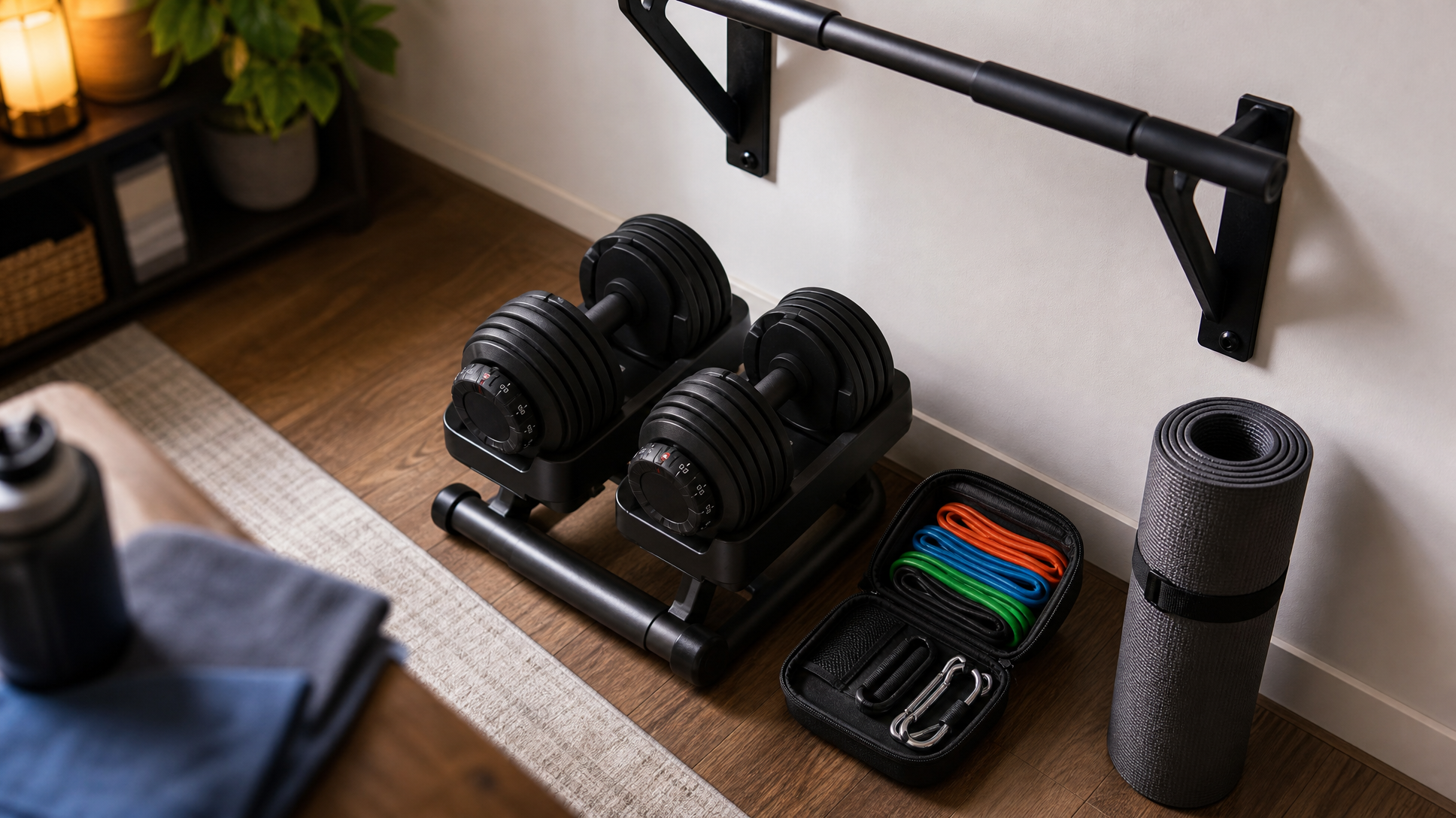
In a small-space gym, vertical real estate matters as much as floor space. Wall-mounted storage for dumbbells, bands, and accessories keeps the floor clear for actual training. A few wall anchors for your suspension trainer, a mounted pull-up bar, and a single shelf for smaller items can transform a cluttered corner into a clean, functional setup.
If you're renting, look for freestanding rack systems that lean against the wall without requiring permanent installation — they're not quite as rigid, but they're a reasonable compromise and they move with you.
What to Skip (At Least for Now)
A few things that sound practical but rarely are in genuinely small spaces:
- Full barbell and plate sets — a barbell is 7 feet long. Even collapsed, storing it is a real problem in a small room. Unless you're specifically training powerlifting movements and have the space, adjustable dumbbells cover the same ground with a fraction of the footprint.
- Multi-station cable machines — the compact versions are better than they used to be, but most still need 4–6 feet of clearance on multiple sides to use safely.
- Full foam roller collections, medicine ball sets, and kettlebell racks — pick one or two, not all of them. Every item that lives on your floor is floor space you can't train in.
The Setup That Actually Works in Under 150 Square Feet
Here's what a functional, complete training setup looks like when you've sequenced it right:
- Adjustable dumbbell set — stored on a small floor stand or shelf
- Folding adjustable bench — stored upright or under the bed when not in use
- Doorframe or wall-mounted pull-up bar
- Resistance band set — stored in a bag or drawer
- Jump rope or folding cardio machine, depending on ceiling clearance and budget
- A quality exercise mat — for floor work, stretching, and protecting your floor
That's it. That covers push, pull, hinge, squat, carry, and cardio. It fits in a room most people would call too small for a home gym. And if you check out our post on home gym essentials on a budget, you'll see a similar principle at work — the order you buy things in matters as much as what you buy.
You don't need more space. You need a better sequence.
Shop compact home gym equipment from 500+ brands — with free US shipping on orders over $75 — at OnlineSportsMall. New customers can use code WELCOME5 for 5% off their first order.
Frequently Asked Questions
How much floor space do I actually need for a functional home gym?
You can build a genuinely functional training setup in as little as 50–70 square feet of clear floor space — roughly the size of a large bathroom. The key is choosing equipment that folds, stores vertically, or serves multiple purposes, and not buying large fixed items (like a full barbell rack or standard treadmill) before you've mapped out your usable floor area.
Are adjustable dumbbells really worth it compared to a fixed dumbbell set?
For small spaces, yes — unambiguously. A fixed dumbbell set that covers a useful weight range takes up significant floor and rack space. A quality adjustable set replaces all of those weights in a footprint about the size of two shoeboxes. The trade-off is a slightly slower weight change between sets, which most home gym users find easy to live with.
Can I get a good cardio workout in a small home gym without a treadmill?
Absolutely. Jump ropes, folding rowing machines, and compact upright bikes all deliver serious cardio conditioning without the footprint of a standard treadmill. Jump ropes in particular require zero floor space during storage and can provide intense interval training — the main requirement is enough ceiling clearance (roughly 8 feet) and, in apartments, a considerate approach to downstairs neighbors.
What's the best way to store gym equipment in a small apartment without it taking over the room?
Use the wall. Wall-mounted hooks, shelves, and pull-up bars keep the floor clear for actual training. For equipment that can't be wall-mounted, prioritize items that fold upright (benches, treadmills, rowing machines) or store in a bag or drawer (resistance bands, jump ropes). The goal is a room that functions as a gym during your workout and looks like a normal room the rest of the time.