

The mistake most people make when setting up a home gym isn't spending too much — it's spending in the wrong order. They buy a treadmill before they've established a running habit, or they grab a full set of dumbbells before they know which exercises they'll actually stick with. Six months later, the equipment is a coat rack and the motivation is gone.
Building a home gym on a budget isn't about buying the cheapest version of everything. It's about buying the right things first — gear that earns its floor space from week one — and holding off on everything else until your routine proves it needs it.
Here's how to think through it.
Start with the Foundation: Bodyweight-First Thinking
Before you buy anything, accept one truth: a well-designed bodyweight workout is harder than most people expect. Push-ups, squats, lunges, planks, and hip hinges can challenge even experienced athletes when programmed correctly. The equipment you buy first should enhance that foundation, not replace it.
This changes your shopping list immediately. You don't need a bench, a barbell, and a rack before you've built consistent movement habits. You need tools that add resistance or variety to movements you can already do — and that take up minimal space while you figure out what your training actually looks like day to day.
Buy First: The Short List That Actually Gets Used
Resistance Bands
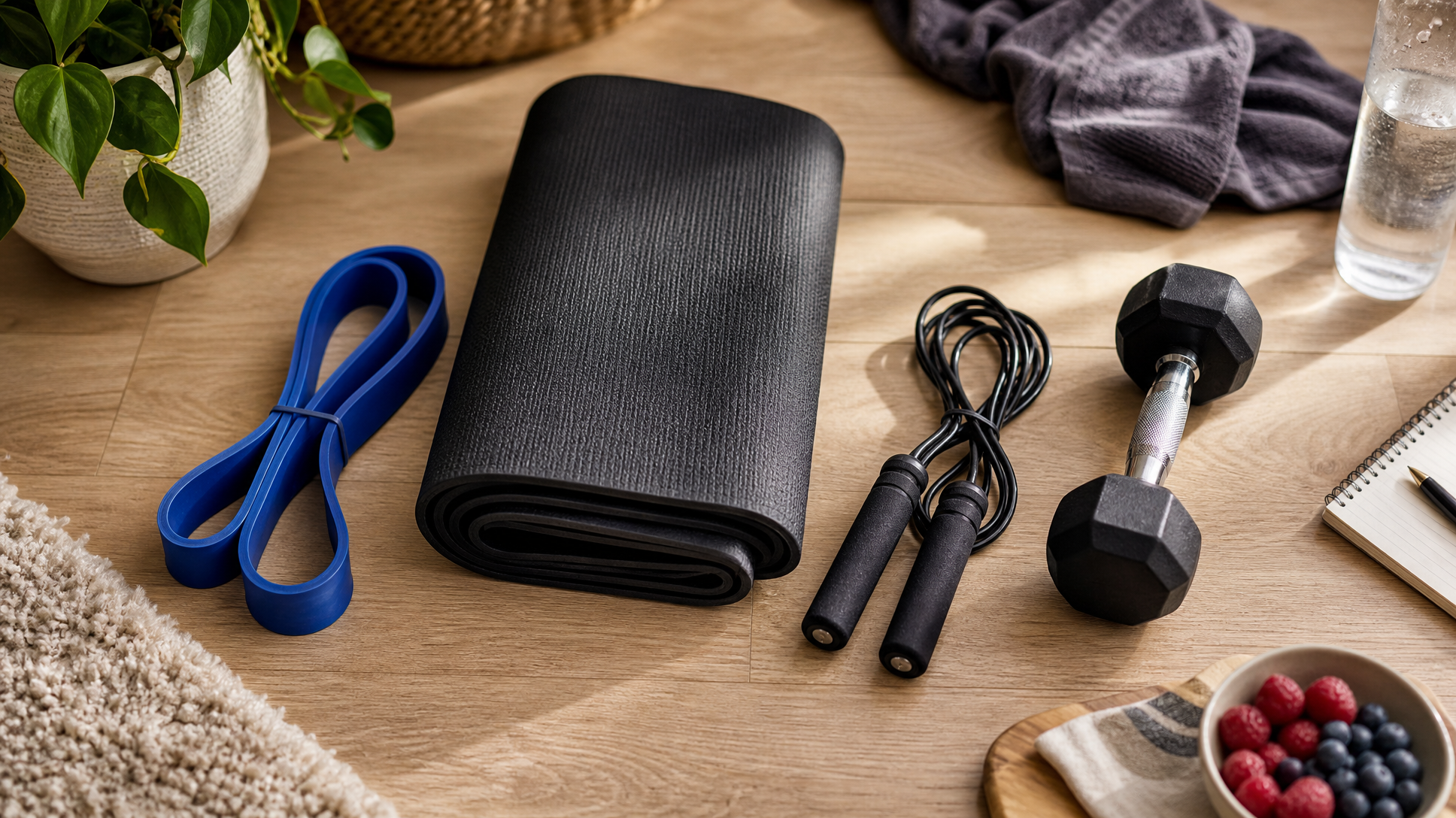
Resistance bands are the most underrated piece of home gym equipment available. A set of loop bands and a couple of handled tube bands covers pulling movements (rows, pull-aparts, face pulls), lower body work (banded squats, lateral walks, glute bridges), and even a rough substitute for cable machine exercises. They're compact, inexpensive, and genuinely versatile across fitness levels. If you only buy one thing first, make it a multi-resistance band set.
A Single Adjustable Dumbbell or a Small Fixed Pair
You don't need a full rack of dumbbells to start. A single adjustable dumbbell — or a pair of fixed weights at a weight that challenges you for goblet squats and rows — covers more ground than most people realize. Goblet squats, Romanian deadlifts, single-arm rows, overhead presses, and lateral raises can all be done with one or two dumbbells if you're willing to get creative with tempo and rep ranges. Buy the rack later, once you know you need it.
A Jump Rope
Cardio equipment is where home gym budgets blow up fast. A treadmill, stationary bike, or rowing machine is a significant investment — and a significant footprint. A jump rope costs a fraction of any of those and delivers a genuinely demanding cardiovascular workout. It's also one of the few pieces of equipment that travels with you. If your goal is general fitness or fat loss, a jump rope earns its keep immediately while you save up for bigger cardio gear later (or decide you don't need it at all).
An Exercise Mat
Floor work — core exercises, stretching, mobility, yoga, bodyweight circuits — is uncomfortable on bare hardwood or concrete. A good exercise mat isn't glamorous, but it's the difference between actually doing your warm-up and skipping it. If you're unsure whether to get a yoga mat or a thicker exercise mat for your specific training style, our post on yoga mats vs. exercise mats breaks down what's actually different between them.
Wait On: Gear That's Worth It — Eventually
A Pull-Up Bar
Pull-ups are one of the best upper-body exercises you can do, and a doorframe pull-up bar is genuinely affordable. So why wait? Because if you can't do pull-up reps yet, the bar sits unused while you build the pulling strength to use it. Pair your resistance band rows and face pulls consistently for four to six weeks first. When those feel too easy and you're ready to load your lats properly, the pull-up bar becomes a smart next purchase — not a first one.
Kettlebells
A kettlebell is a brilliant training tool, but it has a learning curve. Swings, cleans, and Turkish get-ups done with bad form are a fast path to a tweaked back. Once you've built a baseline of hip hinge mechanics through banded deadlifts and dumbbell RDLs, a single kettlebell at the right weight becomes one of the most efficient pieces of equipment you'll own. It's worth waiting for that foundation before you buy one.
A Bench
A flat bench opens up pressing variations and step-up work that's hard to replicate otherwise. But it's also bulky and expensive relative to what you get in the early stages of a home gym. A sturdy chair or a low coffee table can stand in for incline work temporarily. Wait until your pressing volume is high enough that the floor press and push-up variations genuinely limit you — then the bench earns its space.
Cardio Machines
Treadmills, stationary bikes, and rowing machines all have their place. But they're expensive, space-hungry, and often underused. If you're serious about adding one, wait until you've trained consistently for at least two to three months and you know exactly which cardio modality you'll actually stick with. Buying a bike because you think you should like cycling is a reliable way to own expensive furniture.
Skip Entirely (At Least for Now)
Multi-Station Home Gyms
The all-in-one cable machines you see in big-box stores look impressive and promise to replace every piece of gym equipment you'd ever need. In practice, they're enormous, the cable systems on budget models wear out quickly, and most people use two or three of the stations regularly and ignore the rest. Unless you have the space, the budget, and a specific training need that requires cable movements, skip these entirely and build around free weights and bands instead.
Ab Machines and "Spot Reduction" Devices
Ab rollers are fine. Ab machines that promise to target belly fat or sculpt your core in minutes are not. Exercise science is clear that spot reduction — losing fat from a specific body part by training it — doesn't work that way. Core strength comes from compound movements and dedicated ab work; fat loss comes from overall energy balance. Any product marketed primarily around "blasting" a specific area is a skip.
Matching Aesthetic Sets
There's nothing wrong with wanting your home gym to look good. But buying a color-coordinated dumbbell rack, matching resistance bands, a branded mat, and a themed storage system before you've established a training habit is putting the aesthetic ahead of the function. Get the gear that makes you train first. Make it pretty later, if it still matters to you.
The Spending Order, Summarized
- Resistance bands — buy these immediately, no exceptions.
- Exercise mat — floor work without one is miserable.
- Jump rope — cheap, effective cardio that requires zero floor space.
- One or two dumbbells — not a full rack, just enough to start loading movements.
- Pull-up bar — once you're ready to actually use it.
- Kettlebell — after you've built hip hinge mechanics.
- Bench — when pressing volume genuinely demands it.
- Cardio machine — only after you know which one you'll actually use consistently.
The point isn't to be cheap — it's to be deliberate. A home gym built in layers, where each purchase is earned by the training that came before it, is one you'll actually use. A home gym bought all at once, before the habit is set, is one you'll resent paying for.
Browse the OnlineSportsMall fitness collection to find resistance bands, dumbbells, mats, and more from 500+ brands — with free US shipping on orders over $75. Use code WELCOME5 for 5% off your first order.
Frequently Asked Questions
What's the minimum equipment needed to get a real workout at home?
A resistance band set and an exercise mat are genuinely enough to build a challenging, full-body workout routine. Add a jump rope for cardio and a single dumbbell for loaded movements, and you have a setup that covers the majority of training goals — strength, conditioning, and mobility — without needing anything else in the early stages.
Are adjustable dumbbells worth the higher upfront cost?
If you're confident you'll train consistently and progress in weight over time, yes — adjustable dumbbells save significant money and space compared to buying multiple fixed pairs. If you're just starting out and not sure how your training will develop, a single fixed pair at a challenging weight is a lower-risk first buy. You can always add adjustable weights later once the habit is locked in.
Is it better to buy used gym equipment or new?
Used equipment can be a solid option for heavy, simple items like dumbbells, kettlebells, and weight plates — things with no electronics or moving parts that wear out. For resistance bands, jump ropes, and anything with cables or mechanisms, buying new from a reputable retailer is worth it, since wear and material fatigue on those items can affect both performance and safety.
How much space do I realistically need for a starter home gym?
The setup described in this post — bands, a mat, a jump rope, and a dumbbell or two — fits in a space roughly the size of a yoga mat plus a small corner for storage. You don't need a dedicated room or a garage. A cleared living room floor, a spare bedroom corner, or even a covered patio works fine until your equipment list grows enough to justify claiming more space.