

Every fitness machine on the market right now has a Bluetooth logo and an app. Some of them will legitimately change how you train. Others will sync once, sit unused in the background, and add nothing to your workout except a higher price tag and a dead battery notification.
The problem isn't that smart fitness tech is bad. It's that the word "connected" has become meaningless. A treadmill that counts your steps and calls it data is not the same thing as a rowing machine that analyzes your drive ratio in real time. But both boxes say "app-enabled" on the side.
Here's how to cut through it.
The Only Question That Actually Matters
Before looking at any specific device, ask yourself one thing: does the data this machine collects change what I do next?
If the answer is yes — if seeing a number mid-session would cause you to adjust your pace, your form, your split time, or your rest interval — then the smart version is worth considering. If the answer is "I'd glance at it occasionally," you're probably paying for a feature you'll stop using inside a month.
With that filter in mind, here's how common smart fitness devices actually stack up.
Devices Where the Tech Genuinely Earns Its Place
Rowing Machines with Stroke Analytics
Rowing is one of the few cardio disciplines where real-time feedback is almost impossible to replicate any other way. Your stroke rate, drive length, split time per 500 meters, and drive-to-recovery ratio are all invisible to you without instrumentation — and all of them matter for both performance and injury prevention. Smart rowers that surface this data mid-row, not just post-session, give you something actionable while you're still on the machine. That's the standard to hold other devices to.
Smart Stationary Bikes with Power Meters
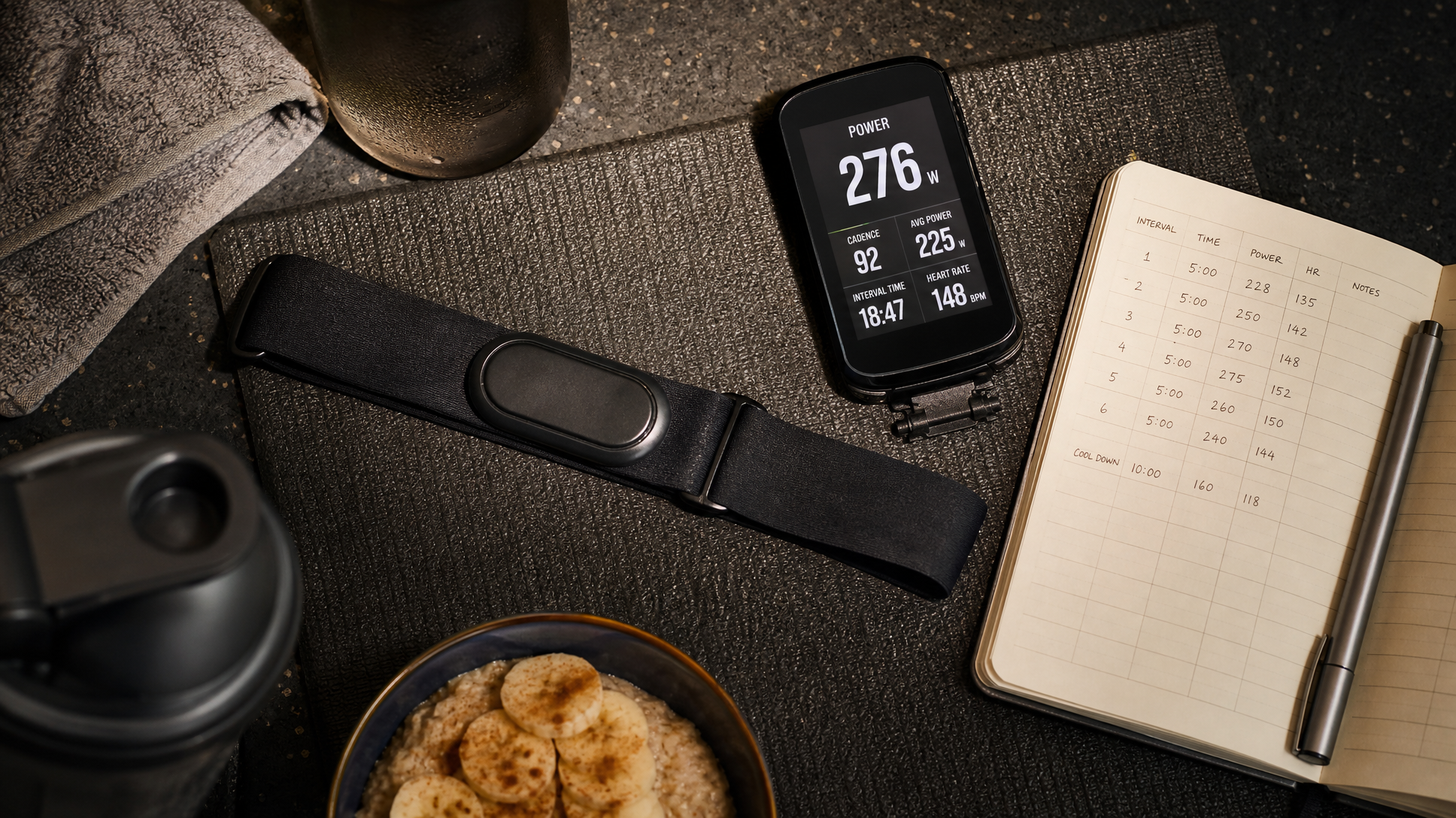
Power output (measured in watts) is the gold standard metric in cycling training because it's consistent regardless of fatigue, heat, or wind. A connected bike that measures real wattage and lets you train in specific power zones is a fundamentally different tool from one that just shows speed and cadence. If you're following a structured cycling program or doing interval work, the power data changes your sessions in a concrete way. The app integration matters here — but only if the app lets you program workouts by zone, not just log what you did.
Smart Jump Ropes
This one surprises people. A connected jump rope that counts jumps, tracks missed rotations, and measures your work-to-rest ratio is genuinely useful for boxers and HIIT athletes who use rope work as a conditioning tool rather than a warm-up. The data is specific, the feedback loop is tight, and the price gap over a standard rope is small enough that it's rarely a bad trade.
Connected Heart Rate Monitors (Chest Strap, Not Wrist)
Not technically a machine, but worth including: a chest-strap heart rate monitor paired to a training app gives you the most accurate real-time heart rate data available outside a clinical setting. Research published on PubMed consistently shows chest straps outperform optical wrist sensors for accuracy during high-intensity exercise. If heart rate zone training is central to your program, this is the one piece of smart tech with the clearest return on investment.
Devices Where the Smart Upgrade Is Situational
Smart Treadmills
Treadmills are the most overhyped category in connected fitness. Most "smart" treadmills do three things: stream content, track distance and pace (which a $30 foot pod does just as well), and offer auto-incline adjustments tied to a subscription route. If you run primarily for general fitness and don't follow a structured program, none of that changes your training in a meaningful way.
The exception: treadmills that integrate with running power meters or offer genuine VO2 max estimation based on multiple data points. Those exist, but they're a small subset of the "smart treadmill" category. Most are just screens with decent speakers. Buy the treadmill for its motor, belt size, and incline range — not the app.
Smart Dumbbells and Adjustable Weight Systems
The connected features on adjustable smart dumbbells — rep counting, form coaching via camera, workout logging — are genuinely useful for beginners who are still learning movement patterns. For experienced lifters who already know their programs and track their own volume, the tech adds friction more than value. You're waiting for the app to confirm what you already know. The adjustable mechanism itself (the actual reason to buy these) stands on its own; the "smart" layer is a nice-to-have, not a reason to pay a significant premium.
Smart Resistance Bands
Some connected resistance bands measure tension and rep count. The concept is sound — resistance band training is notoriously hard to quantify — but the execution varies a lot by brand. If you're doing serious rehab work or physical therapy where precise resistance tracking matters, it's worth investigating. For general fitness use, a standard set of bands and a training log does the same job.
Devices Where You Should Skip the Smart Version Entirely
Smart Foam Rollers
A foam roller with vibration settings is a legitimate recovery tool. A foam roller with an app that guides your rolling pattern is a gimmick. You don't need a Bluetooth connection to roll out your IT band. The vibration function is useful; the connectivity is not. Buy a quality vibrating roller and ignore the app integration.
Connected Pull-Up Bars
Pull-up bars that count reps via sensors sound clever until you realize you can count your own pull-ups. The sensor data doesn't change your next set. It doesn't improve your form. It just tells you what you already know. A solid, properly anchored pull-up bar is one of the best pieces of gym equipment you can own — the smart version adds cost and a failure point with no training benefit.
Smart Water Bottles
Technically fitness-adjacent. A bottle that tracks your hydration sounds useful in theory. In practice, it reminds you to drink water — something you can accomplish with a phone alarm or just by being thirsty. The connectivity here is the product, not a feature that supports a workout. Pass.
How to Decide for Your Own Setup
Run every device through these three checkpoints before paying the connected premium:
- Is the data specific to this activity? Generic metrics (calories, steps, heart rate) are available from your phone or watch. The smart version of a piece of equipment is only worth it if it captures something sport-specific you can't get elsewhere — stroke rate, power output, split time.
- Will you act on it mid-session? Post-session dashboards are satisfying but rarely change behavior. Real-time feedback that prompts an in-workout adjustment is where connected tech pays off.
- Does it require a subscription to be useful? Some smart devices are essentially locked behind a monthly fee for any meaningful functionality. Factor that into the total cost of ownership before you buy.
If a device passes all three, it's a legitimate upgrade. If it fails even one, the traditional version is almost certainly the better buy — and you can put the price difference toward something that actually improves your training.
For a broader look at how the category is evolving, the post on smart gym equipment and what the tech actually does covers the landscape in more depth. And if you're building out a home setup from scratch, the home gym essentials guide is a good place to start before deciding where smart features fit into your budget.
Shop smart and traditional fitness equipment at OnlineSportsMall — compare options across 500+ brands in one place, with free US shipping on orders over $75.
Frequently Asked Questions
Do smart fitness devices require a monthly subscription to work?
It depends on the device and brand. Some connected equipment works fully out of the box and only uses an app for basic tracking — no subscription needed. Others gate their most useful features (structured workouts, live classes, advanced analytics) behind a recurring fee. Always check what the app offers for free versus what requires a paid plan before you buy, and factor that ongoing cost into your decision.
Is a smart fitness device worth it if I'm just starting out?
For most beginners, the smart features add more complexity than benefit. You'll get more value from learning consistent movement patterns and building a training habit than from analyzing split times or power zones. A few exceptions — like a connected bike for guided beginner cycling programs — can genuinely help if the app provides real structured coaching. But in general, start with solid fundamental equipment and add smart features once you know what data you'd actually use.
Can I use smart fitness devices without a smartphone?
Most connected fitness devices require a smartphone or tablet to access their full feature set, since the app is where the data lives. Some higher-end machines have built-in touchscreens that operate independently, but even those often sync to a phone for progress tracking over time. If you prefer to train without a device nearby, check whether the machine's console displays the metrics you need on its own — many do for basic stats like speed, distance, and time.
How do I know if the heart rate data from a smart device is accurate?
Optical wrist-based sensors (built into watches and some machines' handgrip sensors) are convenient but less accurate during high-intensity or high-movement exercise. Chest straps that use electrical signals rather than light are significantly more reliable for real training use, particularly during interval work or anything above a moderate pace. If heart rate zone training is a core part of your program, a dedicated chest strap paired to your preferred app is a more trustworthy investment than relying on a machine's built-in optical sensor.